Reinforcement learning
Pirate Intelligent Agent
I created an intelligent agent that learns how to navigate a maze and locate hidden treasure. The project uses deep Q-learning, replay memory, reward-based decisions, and an epsilon-greedy strategy to improve the agent's behavior through repeated training.
- Python
- Keras
- Deep Q-Learning
- Replay Memory
- Epsilon-Greedy
- Reinforcement Learning
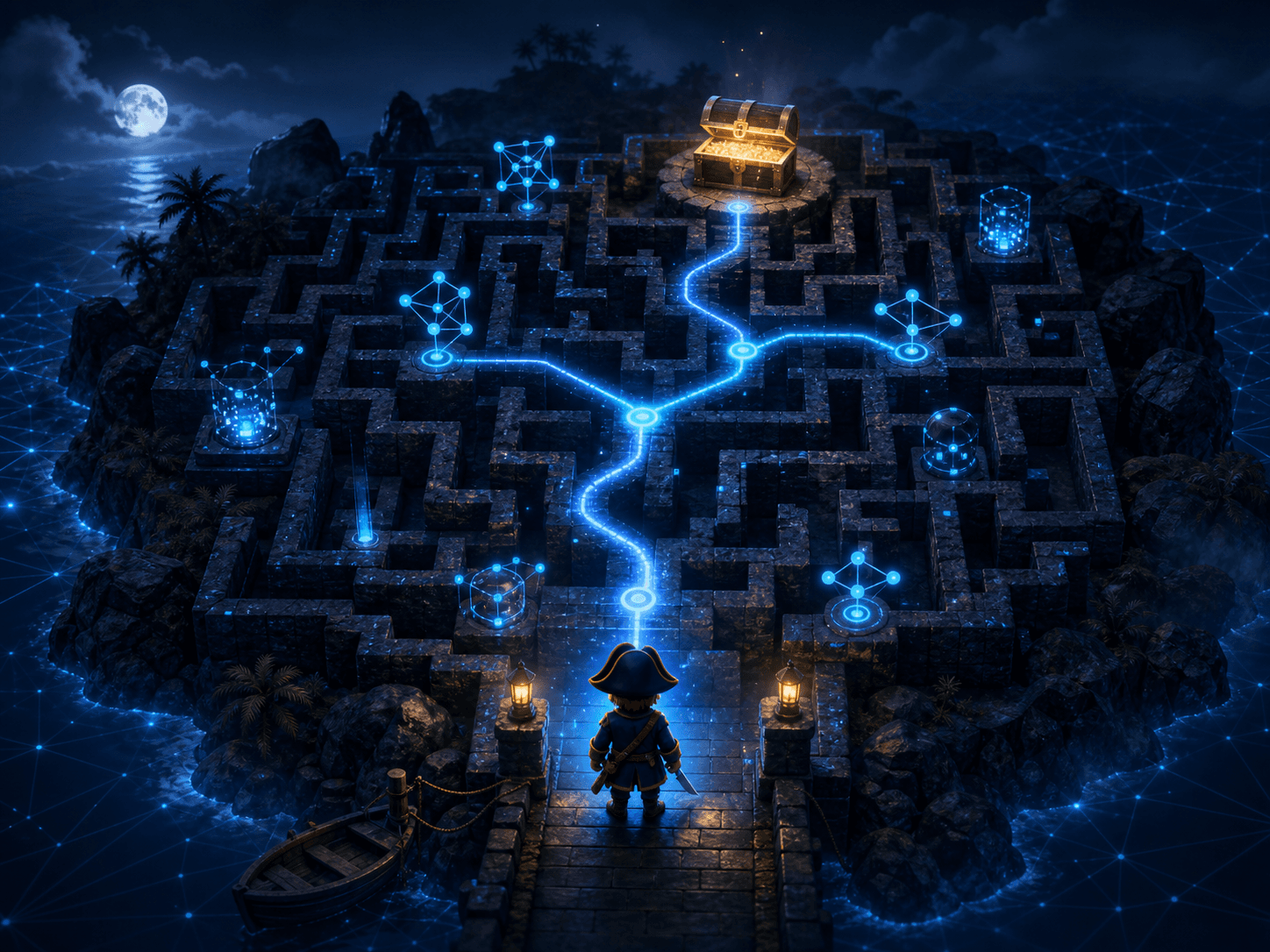
Learning a path through experience
The agent explores different routes, receives feedback from the environment, and gradually favors decisions that lead toward the treasure.
Overview
Teaching an agent without prescribing every move
Instead of programming one fixed solution, I created an environment where the agent could learn from successful and unsuccessful choices. This demonstrates how reinforcement learning can discover useful behavior through interaction, feedback, and iteration.
Project goal
Reach the treasure reliably
The objective was to train an agent that could move through the maze, avoid unproductive actions, and increasingly select a successful route as its experience accumulated.
Learning cycle
Observe, act, learn, and repeat
Observe the state
The agent reads the current maze configuration and its position relative to available movement options.
Choose an action
An epsilon-greedy policy balances exploratory moves with actions predicted to provide the highest value.
Receive a reward
The environment evaluates the move, rewarding progress and successful treasure discovery while discouraging ineffective actions.
Update the strategy
Stored experiences are sampled from replay memory and used to improve the neural network’s Q-value estimates.
Agent design
Connecting the maze to a neural decision model
State representation
The maze state provides the model with the information needed to evaluate legal movement choices and future rewards.
Action space
The agent chooses among valid directional movements as it attempts to reach the goal.
Reward system
Reward-based feedback helps the agent distinguish useful progress from inefficient or unsuccessful movement.
Q-value approximation
A Keras neural network estimates the long-term value of available actions instead of relying on a fixed lookup table.
Exploration strategy
Balancing discovery with learned behavior
The epsilon-greedy strategy lets the agent explore random actions early in training while still using the model's strongest predictions. As training continues, exploration can decrease so the agent relies more heavily on what it has learned.
Replay memory
Learning from a broader range of experiences
Replay memory stores previous state transitions and samples them during training. Reusing varied experiences reduces dependence on the most recent sequence of moves and supports more stable model updates.
Training process
Improving performance across repeated episodes
Reset the maze and place the pirate agent at the starting position
Represent the current environment as a state the model can evaluate
Select an exploratory or learned action with the epsilon-greedy policy
Store the state, action, reward, and next state in replay memory
Train the Keras model on sampled experiences
Repeat episodes until the agent develops a more reliable route to the treasure
Evaluation
Measuring useful learned behavior
- Whether the agent reaches the treasure successfully
- How reliably it completes the maze across repeated episodes
- Whether learned actions replace random exploration over time
- How replay-memory training affects stability and convergence
Challenge & solution
Preventing random exploration from dominating
A learning agent needs enough exploration to discover successful routes, but excessive randomness prevents consistent behavior. I used epsilon-greedy action selection with repeated replay-memory training to shift the balance gradually from exploration toward informed decisions.
Project outcome
An adaptive agent that improves through experience
The project demonstrates my ability to connect reinforcement learning concepts with a functioning Python environment, build a neural decision model in Keras, manage training experiences, and reason about exploration, rewards, and learned behavior.